
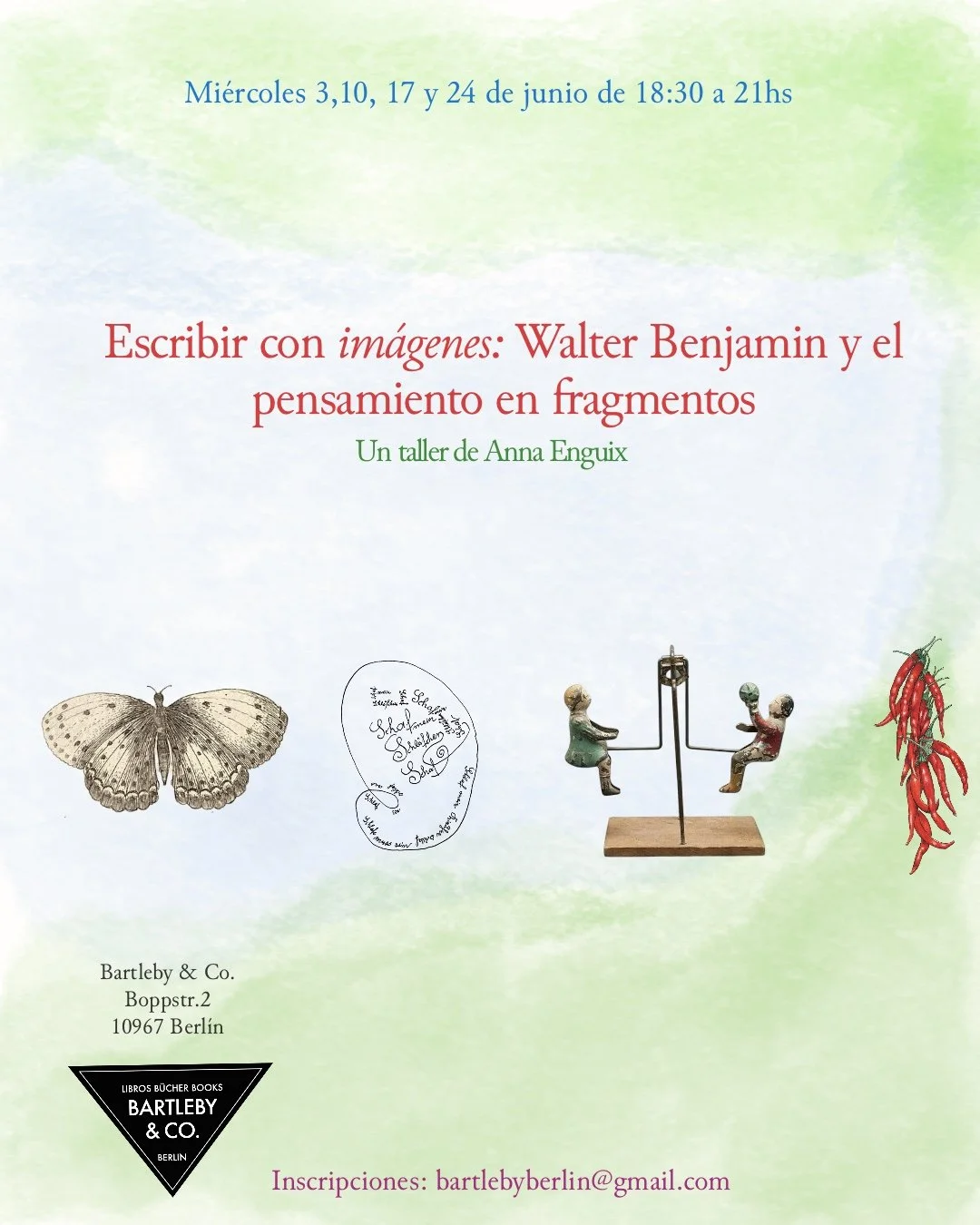
Walter Benjamin y el pensamiento en fragmentos
Walter Benjamin and Thinking in Fragments
Curso impartido en la librería Bartleby & Co. de Berlín, concebido como un recorrido por el pensamiento de Walter Benjamin a partir de una de las características fundamentales de su escritura: el fragmento como forma de pensamiento y como modo de aproximación a la experiencia moderna. Estructurado en cuatro sesiones, Ante el tiempo, Comer, Jugar y soñar y Entre (varios) mundos, el curso propuso una lectura transversal de la obra benjaminiana a través de textos, imágenes y materiales diversos. Frente a una aproximación estrictamente cronológica o sistemática, las sesiones se articularon mediante asociaciones, constelaciones y diálogos entre conceptos, autores y experiencias, siguiendo una lógica próxima al propio método de Benjamin.
A lo largo del curso se abordaron cuestiones como la memoria y la relación entre pasado y presente, la imagen y la historia, la experiencia de lo cotidiano, el juego, la infancia y la imaginación, así como el viaje, la ciudad y el tránsito entre espacios y culturas. Los textos de Benjamin se pusieron en relación con autores como Marcel Proust, Lisa Fittko, Ernest Hemingway, Vicent Andrés Estellés y Georges Didi-Huberman, ampliando la reflexión hacia la literatura, la filosofía y la cultura visual. El curso planteó así la lectura de Benjamin no solo como objeto de estudio, sino también como una práctica: una forma de pensar mediante fragmentos, imágenes, recuerdos y conexiones capaces de construir nuevas constelaciones de sentido.
Course taught at Bartleby & Co. bookshop in Berlin, conceived as a journey through Walter Benjamin’s thought based on one of the defining features of his writing: the fragment as a form of thought and as a way of approaching modern experience. Structured in four sessions, Facing Time, Eating, Playing and Dreaming, and Between (Several) Worlds, the course offered a transversal reading of Benjamin’s work through texts, images, and a variety of materials. Rather than following a strictly chronological or systematic approach, the sessions were organised through associations, constellations, and dialogues between concepts, authors, and experiences, reflecting a logic closely related to Benjamin’s own method.
Throughout the course, participants explored questions of memory and the relationship between past and present, image and history, everyday experience, play, childhood and imagination, as well as travel, the city, and movement between spaces and cultures. Benjamin’s writings were brought into dialogue with authors such as Marcel Proust, Lisa Fittko, Ernest Hemingway, Vicent Andrés Estellés, and Georges Didi-Huberman, extending the discussion across literature, philosophy, and visual culture. The course thus approached Benjamin not only as an object of study, but also as a practice: a way of thinking through fragments, images, memories, and connections capable of creating new constellations of meaning.
